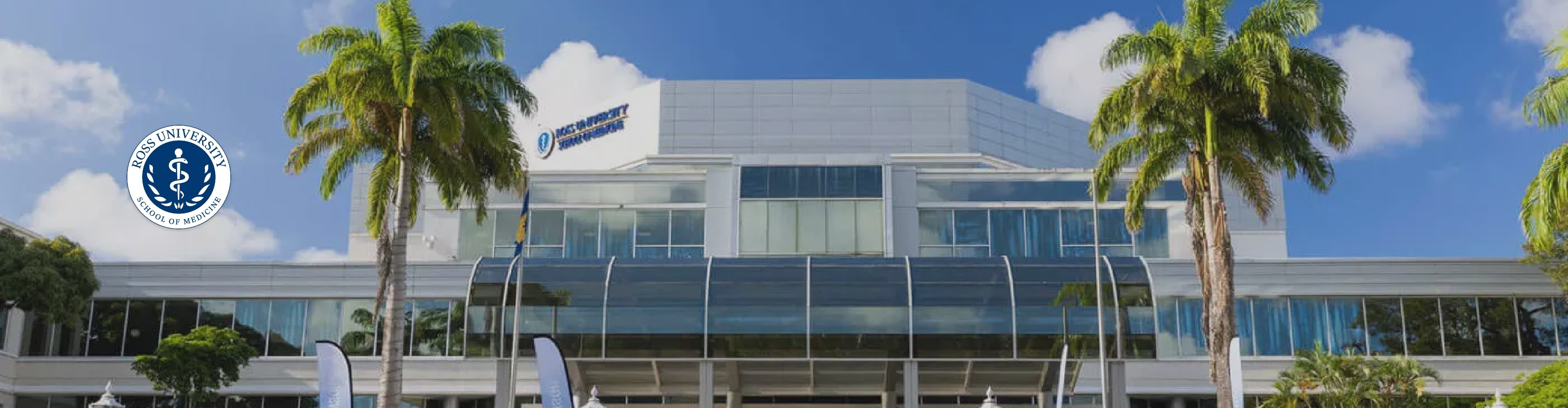
Ross University School of Medicine
Request Information
ROSS University School of Medicine
Study Medicine in USA
Ross University School of Medicine is offering select admissions to qualified Indian students who complete the AMP program. Ross University School of Medicine's 4-year graduate entry medical program includes 20 months of basic science courses in Barbados and 90 weeks of clinical training in the United States. Ross University School of Medicine graduates earn an MD (MBBS equivalent) designed to prepare students to enter a US residency program. Ross University School of Medicine has a 98% residency match rate. Together, SAGE and Ross University provide a comprehensive pathway that prepares students for success in medical school and future residency opportunities.
Integrated Medical Curriculum
Ross University's MD curriculum combines foundational medical sciences with early clinical application, patient simulations, and community health experiences to prepare students for the United States Medical Licensing Examination (USMLE®) and clinical rotations. Learning is reinforced through case-based instruction, simulation training, and practical assessments that build clinical reasoning and decision-making skills.
Learn from Experienced Medical Faculty
Students are guided by accomplished medical educators, clinicians, and healthcare professionals who emphasize evidence-based practice, ethical decision-making, and patient-centered care. Personalized mentoring, continuous academic guidance, and collaborative learning environments support students throughout every stage of their medical education while encouraging professional growth and lifelong learning.
Clinical Learning Powered by Innovation
Ross University enhances medical education through its advanced Simulation Institute, high-fidelity simulation technology, standardized patient encounters, and modern clinical skills laboratories. Students gain hands-on experience in a safe learning environment before progressing to clinical rotations, while technology-enabled resources and a diverse international student community provide valuable global perspectives on healthcare delivery.
Comprehensive Support from Admission to Residency
SAGE supports students throughout the pre-departure journey with personalized counselling, IELTS/TOEFL preparation, admissions guidance, visa assistance, and orientation programs. Once enrolled, Ross University provides academic advising, wellness resources, dedicated Learning Communities, residency preparation, career development services, and access to a global alumni network, ensuring students receive continuous support from their first semester through residency planning.
Accreditation & Global Recognition
Ross University School of Medicine is accredited by the Caribbean Accreditation Authority for Education in Medicine and other Health Professions (CAAM-HP), whose standards have been recognized as comparable to those used for MD programs in the United States. Its Simulation Institute is also accredited by the Society for Simulation in Healthcare (SSH). Ross graduates are eligible to pursue ECFMG certification, participate in the National Residency Matching Program (NRMP), complete the USMLE®, and seek medical licensure in accordance with the requirements of individual countries and jurisdictions.
Your AMP Path To a US Residency Program:
Required Qualifications:
- Secondary School Completion
- NEET qualified
Successful Completion Of The AMP Program
Provisional Admission
to Ross University School of Medicine
Medical School
at Ross University School of Medicine
4-Year Medical School Program
US Residency
Ross University School of Medicine
has a 98% residency match rate
Practice Medicine
Integrated Medical Curriculum:
Ross University's MD curriculum combines foundational medical sciences with early clinical application, patient simulations, and community health experiences to prepare students for the United States Medical Licensing Examination (USMLE®) and clinical rotations. Learning is reinforced through case-based instruction, simulation training, and practical assessments that build clinical reasoning and decision-making skills.
Key Elements of the AMP Curriculum:
- Medical Applications: Introductory Physiology
- Clinical Reasoning: Patient Centered Problem Solving Skills
- Medical Metacognition: How To Think Like A Doctor